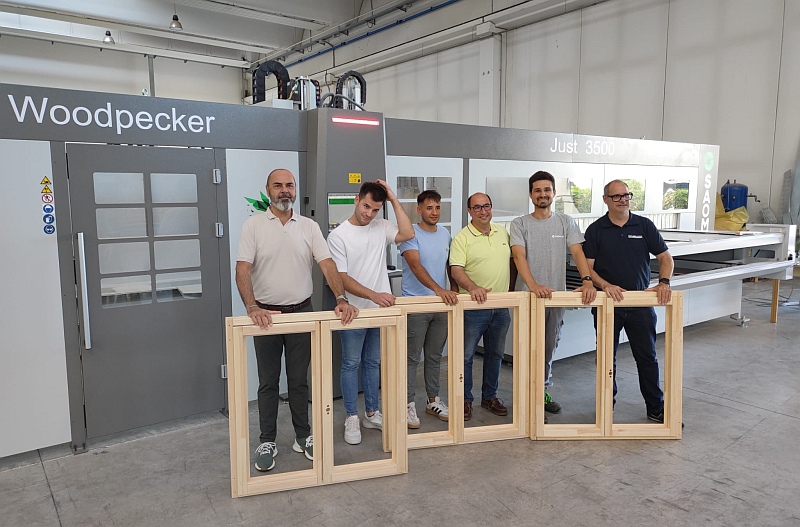
Fusteria Gascon has been manufacturing windows for four generations. Already a Saomad customer for over twenty years with an Operator 5 mitre saw, the company decided to take a technological leap forward by installing the Woodpecker Just 3500.
In this interview, conducted alongside Luis Ros of Simatec, the Spanish firm explains the reasons behind its choice: value for money, delivery times and the continuity of the personal relationship.
There comes a point in the history of a joinery workshop when tradition meets the need to produce in a different way. For Fusteria Gascon, a family-run business near Barcelona, that moment arrived with the fourth generation. Eight people, a market built on replacing windows and doors in historic buildings in the city centre and in the villas of the area, and window production that had always relied on an angle moulder and a pantograph.
The switch to the Woodpecker Just 3500 is how the company has chosen to industrialise the first stage of production – namely, the machining of wooden profiles – whilst maintaining the quality for which it is recognised in its market. We have gathered the testimonies of the owners and of Luis Ros, owner of Simatec, who supports the client in the Spanish market with a complete package of machinery, tools and software.
Who is Fusteria Gascon, and how did the relationship with Saomad begin?
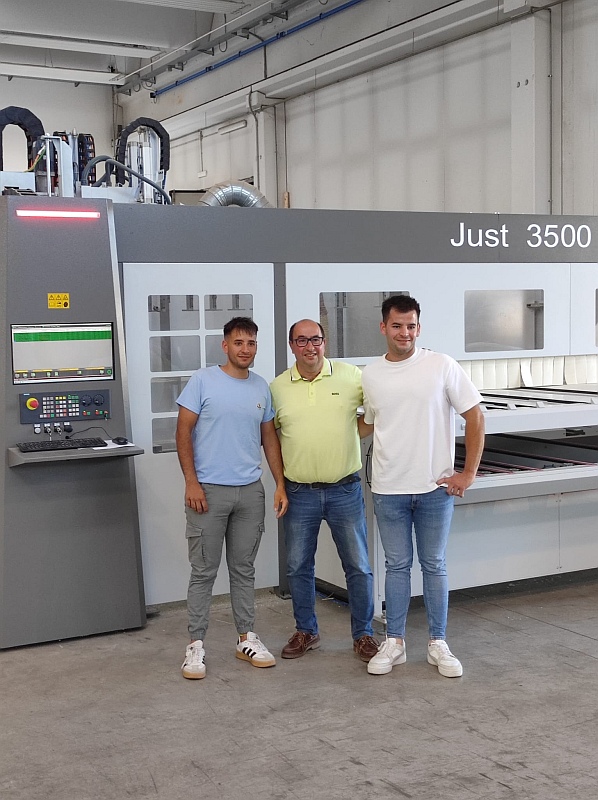
Let’s start with the company. Who is Fusteria Gascon today?
Luis Ros (Simatec): It is a traditional joinery near Barcelona, now in its fourth generation. Eight people – a small business, not a large-scale operation. They mainly work on replacing windows and doors, particularly in Barcelona’s historic centre, as well as on villas. They have always produced windows using both mitre saws and pantograph machines, the latter for curved work. With the new generation at the helm, they decided to raise the bar: to produce more, with higher quality, and to industrialise the initial stages of the work.
How did you come to be in contact with Saomad?
Josep Gascon (owner): Actually, we were already familiar with Saomad. We have an Operator 5 mitre saw that’s been in operation for twenty, perhaps twenty-five years. It’s always been a machine we’ve been happy with. When we started thinking about the generational change, the initial idea was to replace the mitre saw with another Saomad mitre saw.
Luis Ros: That’s when our sales representative, Sergio, stepped in and made it clear to him: these days, the technology isn’t in the angle press anymore; it’s in a machine like the Woodpecker Just 3500. They came to Italy to see the machine and realised straight away that this was the way forward.
Josep Gascon: It was almost love at first sight. For a company like ours, the Just is the right machine: it’s just the right size and format for us. It’s the most compact of the machines Saomad builds using this technology, perfect for those who want to move from a traditional machine to something more high-performance without going overboard.
Comparing the market
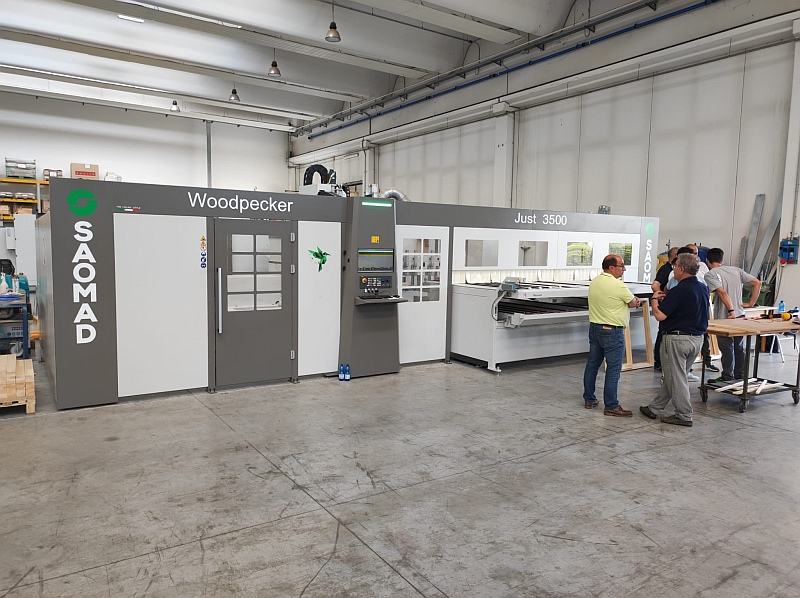
Before making your decision, did you consider other manufacturers?
Josep Gascon: Yes, we looked at others as well. But in terms of value for money, Saomad seemed the most solid choice. For the same outlay, the machine you get isn’t the same. With top-of-the-range manufacturers you pay much more; with more affordable ones, the end product doesn’t measure up. Saomad strikes the right balance.
Guillem Gascon (sales manager): Before making our decision, we also asked around – other window and door manufacturers and suppliers in the sector. Almost all of them, even without ever having worked with the machine, had heard good things about it. For an investment like this, what the manufacturer tells you isn’t enough; you want feedback from people who do the job just like you.
Luis Ros: And the market figures back this up. Today in Spain, Saomad is already the leading manufacturer in terms of the number of machines specifically designed for window and door production. The installations across the country speak louder than any brochure.
The production system and lead times
What struck you when you arrived at the factory?
Josep Gascon: The production system. We saw a highly industrialised operation, and consequently short lead times. For us, that was a decisive factor: we already had approved orders, but the lead times we were being quoted elsewhere were longer – sometimes by as much as a year. Such a long wait, with work on hold in our order book, wasn’t sustainable.
Luis Ros: This is where the real difference lies, and I say this as a supplier who also works with other manufacturers, because I sell tools and software even to those who install machines from other brands. Saomad produces in modules: a single module can be used for three or four types of machine, so the key parts are already in stock. This enables rapid deliveries.
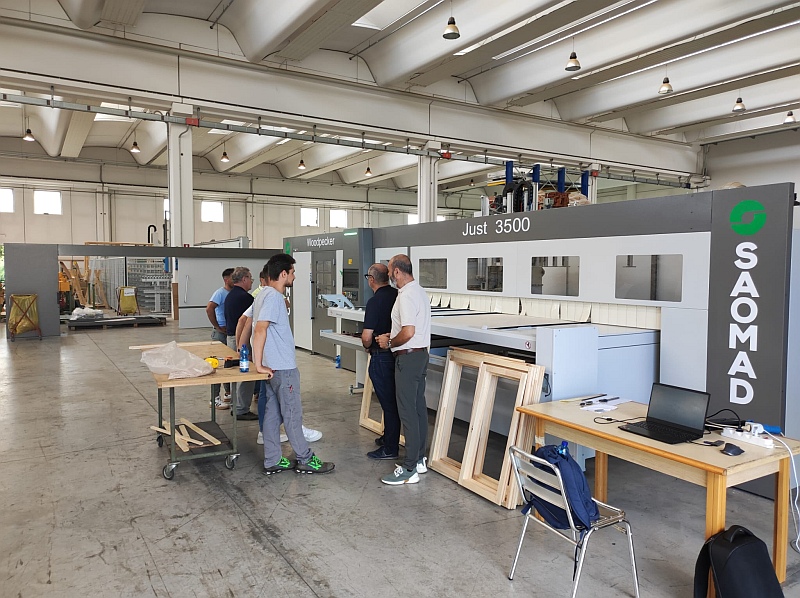
Adherence to deadlines is a theme that comes up frequently in your account.
Luis Ros: It’s the point I emphasise most. Saomad is committed to all the deadlines in the process, and meets them: when the machine is ready, when the tools are ready, when the software is ready, when the customer comes for acceptance, and when delivery takes place. Everything is planned well in advance.
Guillem Gascon: Let me give you a concrete example. I booked my flights to come to Italy for the acceptance tests at the end of April. They’d given me the date four or five months in advance and it was definite, so I bought the tickets without any hesitation. With another supplier, I’d never have dared to book a flight so early, because you know right from the start that the date will be pushed back.
Luis Ros: And I can confirm this from my own perspective, as I deal with quite a few manufacturers. Others give you dates and then fail to stick to them, and that’s when the first tensions arise between manufacturer and customer. At that point, we end up caught in the middle too, even though we’d delivered the tools and software on time.
The first test
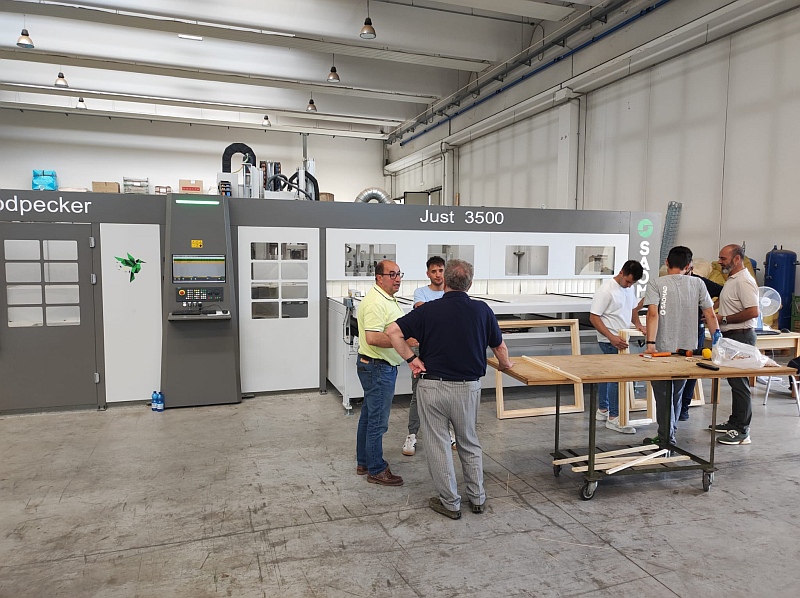
What were your impressions of the assembly and the first test run?
Josep Gascon: Very good. The assembly is well finished and meticulous. We’d already had a glimpse of it during a previous visit; now we’ve confirmed it on our own machine.
Luis Ros: The initial feedback has been positive. They can see that the machine, software and tools all work together seamlessly on the same production line. This is exactly what a window and door manufacturer expects: an integrated workflow, with no breaks between the components.
Beyond the machine: the people
Beyond the technology, what did you appreciate about Saomad right from the start?
Guillem Gascon: The personal relationship – for us, that’s a ten out of ten. We get on really well with Vanessa from the sales department; I’ve called her several times and we have an excellent personal rapport. It’s the same with Claudio Filippi, Saomad’s sales manager: he’d been looking after us even before that; we bought our first Saomad machine through him. I’d ring him and he’d always answer. We’ve also got on well with the machine technician; he explains things clearly.
Luis Ros: It’s the relationship that makes the difference – administratively, commercially and technically. When you buy a machining centre, you’re not just buying the machinery; you’re also buying the people who’ll be supporting you for years to come.
The final question
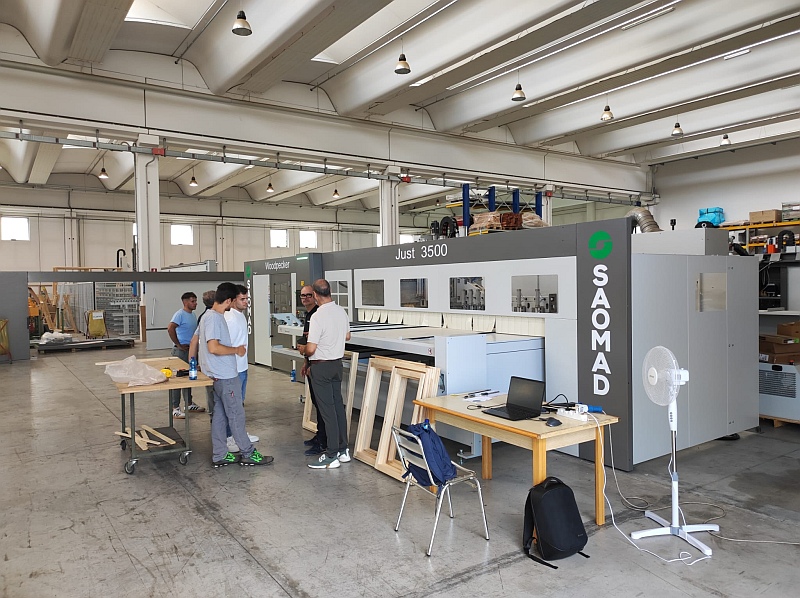
Would you recommend a Saomad to a colleague in the industry?
Josep Gascon: I’d tell them not to buy one, so we don’t have any competition.
Guillem Gascon: Joking aside, it’s still too early to say for sure. We want to see the machine running for eight or nine hours a day without any problems first. But I’ll be honest: yes, I’d recommend it, even if it’s counterproductive for us.
Luis Ros: And I can confirm that Spanish customers, and Saomad itself, already have machines operating at exactly these rates, without a hitch. It’s just a matter of running the Just for a few weeks.